

Recently The New Yorker interviewed me for their article, “The Humanism Driving the Anti-AI Movement.” It revolved around the Pro-Human Assembly in DC I attended, at which both Bernie Sanders and Steve Bannon spoke, and the article includes snippets from me.
For the most part, the going concerns were not about matters of policy as much as they were about matters of philosophy. The neuroscientist and writer Erik Hoel, who sported an impressive beard, told me that he hated that A.I. compromised human freedom. “I want a world where my kids are able to matter in the way that our generation was able to matter and make choices,” he said.
Of course, it’s nice to have The New Yorker’s official blessing for my beard, but overall, the changes to our world are increasingly depressing. During my life culture has taken hit after hit, first in the form of rampant politicization and culture war mishmash and grifting, and now culture is being enervated by AI. And one thing I’ve been personally struggling with is how much to tell my kids about the technological developments that will define their entire lives—especially as my kids are just now starting to actually get good at things, and develop talents… any of which AI off the shelf can be superhuman at.
But right now they know basically nothing about AI, which is excusable because they are 5 years old, 3 years old, and 3 months old, respectively. And I have absolutely zero patience for the idea that kids should get heavy exposure to AI as early as possible, because I firmly believe that education should recapitulate civilization.
This is an idea stolen from the famous phrase in biology, that “ontogeny recapitulates phylogeny,” and embryos go through all their prior ancestral forms.
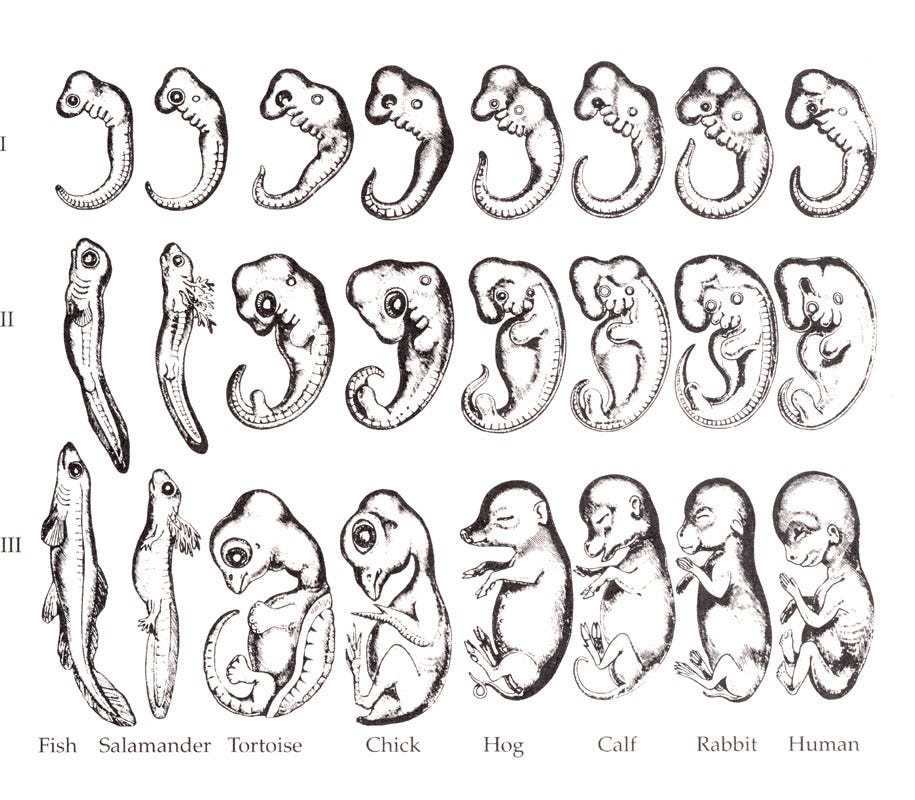
It’s mostly wrong, of course. But it’s still a beautiful and elegant idea, and it’s right enough to be interesting, like how baleen whales grow teeth in the womb before absorbing them and replacing them with bristles, or how human embryos sprout a small tail that shyly retreats.
So too do I think education should recapitulate civilization—by which I mean the progress of civilization. First, the baby lives in a stone-age world where the most interesting things are objects and how they form into tools; next comes art, before even language—attractive patterns, the making of pictures and colors as if on cave walls, as these are tools extending into the abstract realm; then comes language and thought, and the sparks of reasoning and planning; then, literacy, the big bang, as oceans of knowledge begin to pour into the waiting receptacle; following that, mathematics, as reasoning reaches its apotheosis and the mind accesses the platonic realm, and so on and so forth. In terms of what this means practically, the progression focuses on first the physical world and the people in it, then oral culture as stories are mainly told (either read aloud by parents or listening to Yoto players), then after that literacy itself, and then films are introduced like Disney classics or Studio Ghibli, then more complex, longer books—we are here—and then eventually television, video games, the internet, social media, and finally, at the end of intellectual development, artificial intelligence.
A child following this path is then a synecdoche for history, and I think it is neurologically healthy and natural for a human brain to develop via the same path of human civilization itself.
This isn’t anywhere near as strict as it probably sounds, to be honest—more like guidelines than rules, with plenty of wiggle room and exceptions. But still, what I certainly wouldn’t allow is any kind of AI, and at the same time that these machines are becoming superhuman at programming, and now math, my eldest is starting to get good at things. He’s been reading independently for almost two years now, since he was three. One thing I didn’t expect is that it’s made him interested in pictures, so he draws, all the time, long-running paracosms of worlds and characters. I don’t draw, never had any interest or talent in it, so this feels entirely him. He practices by copying from his growing library. Last week he showed me a still life of fruit? It’s like he’s inventing drawing from first principles, and his silly pictures have tricks in them that feel oddly professional, being drawn from specific perspectives, like a sketch looking out from over a table into a wider room. The below photo is literally what I woke up to this morning at 7AM—him copying a style from a book and drawing the comic characters over and over: