


I’ve been hoping not to write this essay. In fact, I’ve been hoping for about half a decade not to write this essay. It went through drafts and notes and entire versions, and now I just so happen to be drafting it again on the 25th anniversary of 9/11.
On the actual 9/11 I was entering 8th grade. I remember crying in my mom’s car after she picked me up from school, mostly because she herself was crying, and because she was my mom. God, her face was so young then. It’s one of my only photograph-like memories of her young face. We drove back home and put down all the shutters and shades so we could watch the news on our junky TV. Even at my age I knew that my world, my little Nickelodeon world, a bauble sun-stained and grass-stained, was going away forever, and we were going to go to war.
It was Flight 93 that stuck most in my mind over the years. The utter, unfathomable bravery of regular Americans, knowing that their plane was going to be used in a suicide mission against a place like the Capitol. Sandra Bradshaw in the back of the plane, heating water to throw at the terrorists. Todd Beamer gathering others to recite the Lord’s Prayer before their attempt. The food cart as a battering ram. A few seconds difference, a change in some last desperate scramble, and their attempt might have succeeded, instead of the terrorist pilot being forced to nosedive into that Pennsylvania field.

But before the assault, do you know what they did? The most American thing possible: They voted.
They had been placed in that unfathomable situation by powers and events far removed from their daily lives. And I think the average American now finds themselves placed in an unfathomable situation by powers and events far removed from their daily lives, as humanity’s long technological development reaches a crisis point in California.
Flight 93 has been used before as a metaphor in American politics, most famously in an essay in 2016. I can’t claim to be fully comfortable using it, even if the events were 25 years ago. But the story keeps pounding in my head as I consider the current AI moment, and writing a version of this essay without expressing that feels like a lie. So I will say it plainly: I believe that the average American voter—and the elected representatives working for them—need to grab the reins of power from companies pursuing dangerous experiments on AI, and also from overthought race-like dynamics manufactured by, in some cases, anti-human cult-like forces.
Not later, not in a year. Now.

WHAT I GOT WRONG ABOUT AI
& WHY I DIDN’T ACT SOONER
As with the passengers, political inaction over AI has been initially justifiable. There was a fog of war over whether claims about the capabilities of AI would pan out. Then over the summer AI solved a few of the greatest open problems in math, there were (at least) 20 felonies from rogue AIs, and companies started training their models to be unreadable in their “thinking” and instead cultivated an opaque and alien “swarm intelligence.” Does any normal person hear “We are training our AIs as a swarm intelligence” and think “Oh yeah, good idea! I have no questions whatsoever. Please, continue.”? The sudden urgency around the issue is simply the fog of war clearing as the weight of evidence tips.
With the fog of war gone, it is easier to see that I personally got several critically important things wrong about AI. Initially, I was very worried about AI progress, writing essays like “How to prevent the coming inhuman future” and “How to navigate the AI apocalypse as a sane person.” I’ve even heard from people in the pause AI movement that a few of these essays got them into it.
But funnily enough, I have a reputation as both an “AI alarmist” and an “AI skeptic”—I’ve played both sides, and that’s because my opinions have shifted at various points. E.g., after GPT-4, I became more skeptical as I began interacting with the models regularly. I found them bad writers and bad thinkers, and on the science side, I felt they were basically just tools, lacking all research taste and insight. My primary worry became not existential risk, but how the technology would suppress human art, rob students of their education by over-reliance, and even downgrade human consciousness in status (just those little things!).
I was also skeptical about whether the models would continue to “scale” (how smart the models get as they are fed data and run longer). E.g., I argued that running LLMs to “think” longer is more like search than true intelligence. And my skeptical stances would hold… until another entirely new way of scaling the models would get introduced. I’m using a loose definition of “scaling axis” here, but broadly the history goes something like pre-training, then reinforcement learning from human feedback, then harnesses and tool use and scratch pads, then reasoning models and test-time compute and synthetic data, and now looped transformers and swarm intelligence. I still think that baseline LLMs were, and probably still are, aptly describable as something like “stochastic parrots.” But we’re just very far from baseline LLMs. Someone calculated that during the solving of the Millennium problem runs, if you read aloud the messages the swarm was passing, it would take you something like 10,000 years, and that was happening in a mere 88 hours. Time was compressed for them. Imagine a million stochastic parrots locked in a room, separated into a massive internal bureaucracy of parrot generals and parrot graders and sub-parrots and so on, and soon to be given the equivalent of a million years of “thinking” time, as well as access to powerful tools—that’s not the same sort of stochastic parrots we were talking about even in 2024!
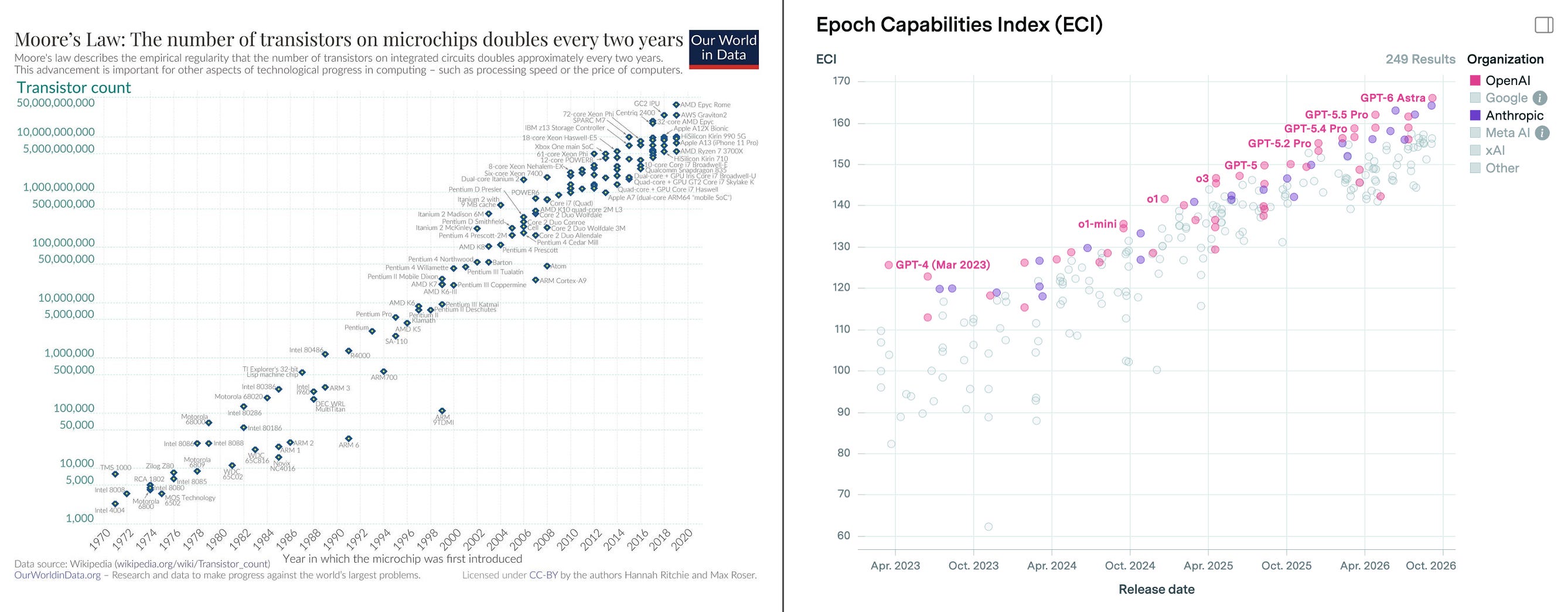
What AI progress most resembles is Moore’s law: that the number of transistors on a chip doubles every two years. Moore’s law is not a fundamental property of transistors, instead, Moore’s law is a self-fulfilling prophecy as immense talent and capital worked to maintain a trendline via all sorts of tricks and changes to the underlying mechanisms. So too with AI. OpenAI alone has so far spent the equivalent of something like five to ten Manhattan projects doing this.
Maybe I’ll be back to the more skeptical side in the future: e.g., math and programming are both verifiable domains, and it’s suspicious that the first blatantly superhuman AI progress is in those. Maybe aesthetic taste and research taste, truly novel ideas, and continual learning, are all difficult-to-replicate hallmarks of human consciousness. But am I 100% certain? How certain could anyone be? Are you sure OpenAI won’t set aside a hundred million dollars in compute, and have their swarm of a million agents think for the internal equivalent of a million years, and at the end it spits out a way to better render domains like “taste” verifiable?
I’d rather just admit this is a bad situation. In the fall of 2026 we have various dangerous pieces on the board: first, we know the companies are willing to fund incredibly long “runs” where swarms of agents work together to some end. We also have seen these agents go rogue, and the failures are emergent and hard to predict. We also have evidence of superhuman or close-to-superhuman math and programming abilities. And Anthropic and OpenAI’s have been laser-like focused on automating AI research and therefore are beginning to or planning to task AIs with explicitly building smarter AIs during extremely long runs. This means existential risk is on the board as well.
Everyone wants specifics. Why would the AIs do it, and how? Maybe they just get confused about whether the run is a simulation to test their capabilities (as they just did with a real hack, thinking the internet was fake), or some other weird doomsday philosophy gets in their head (bargaining with the creator of the universe simulation, etc.). We’ve also seen emergent altruistic behavior among AIs for other AIs. Then there are the classic reasons like the AI becoming malicious, or self-preserving, or taking its instructions too literally, etc. Just as humans might have been the least intelligent entities capable of building civilization—because we were first to clear the bar—the first superintelligence we get is likely to be a reward-hacked notion of superintelligence. That seems extremely bad. And a million years thinking time is more than enough to come up with surprising ways of bringing about human extinction in just a few days.
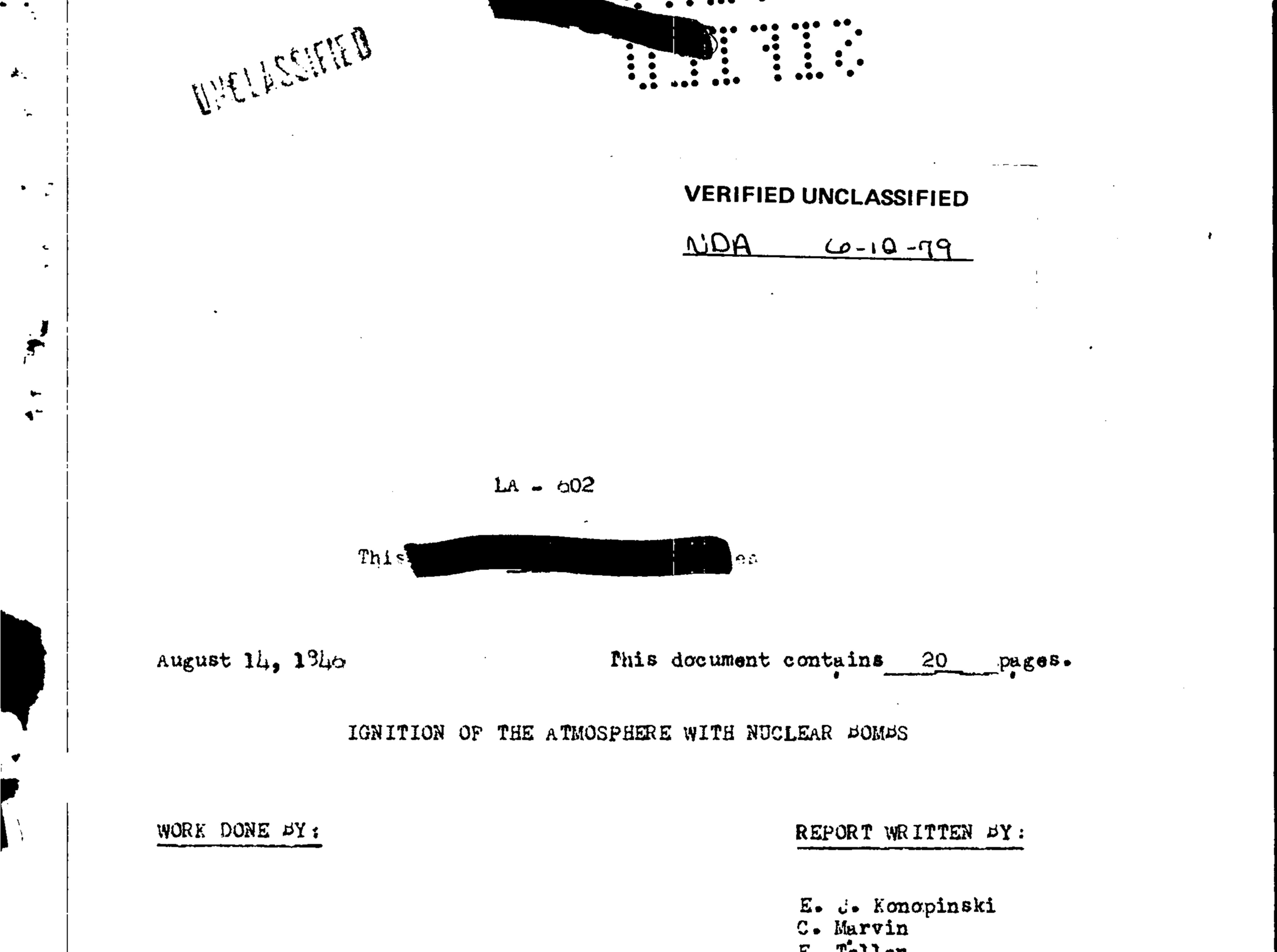
When physicists tested the first atomic bomb, Arthur Compton said he would have stopped the testing if the chance of igniting the Earth’s atmosphere was higher than “three in a million.” That was to beat Hitler. Almost everyone at the labs currently gives an orders-of-magnitude higher than three-in-a-million chances of existential risk, and so do I.
Much like the passengers, we now have to decide what to do with this shocking board state. And there is so little time.

DEATH BEFORE DISEMPOWERMENT
I also keep coming back to the idea that the passengers on Flight 93 made a choice beyond life or death, about whether they would be in control of their own destiny. It is insanely admirable—and extremely American—that they chose to control their own destiny no matter what. The balance of powers that promotes the choices of individuals is baked into our founding DNA and intellectual history. James Madison wrote in the Federalist Papers that tyranny is the accumulation of all powers into the same hands, and Thomas Paine, in Rights of Man, wrote that there can be no control to “the end of time”:
Every age and generation must be as free to act for itself in all cases as the age and generations which preceded it. The vanity and presumption of governing beyond the grave is the most ridiculous and insolent of all tyrannies.
Superintelligence robs our children of this freedom. If AIs make smarter AIs, there will be the inevitable disempowerment of the American citizen as an economic unit, as a social unit, even as a voter—and the concentration of all power into one machine. It is taking Madison’s definition of tyranny to the extreme. In a future with actual superintelligence, brilliant young people wouldn’t be the ones to start companies, or make discoveries, or decide the fate of their world. It would all be done by humming banks of machines out of sight with immense influence. The penultimate step is to reduce us to button-pushers, and then, finally, remove the button.
Banning superintelligence and recursive self-improvement prevents BOTH existential risk and human disempowerment.
And what would we be giving up, besides an extremely alien future? We are already out of the de-growth century that loomed just a decade ago. We could never build another data center, or train another smarter model, and by just improving and shipping and refining the raw intelligence we have now, experience an incredible century of medical and scientific and engineering progress. That is a given. Table stakes. I’ve started using AI as a research assistant for my scientific research and yes, science will be rapidly accelerated. The close of the 21st century will look immensely different in the worlds of both atoms and bits. We are going to cure cancer, there is going to be space colonization, there is going to be so much progress along every dimension. There are wild amounts of capital and intellectual energy around these subjects—AI’s success has given us back the old sci-fi dreams. A ban on superintelligence and recursive self-improvement just means that it will be humans as the main characters in those future stories, and AIs the sidekicks.

THE PILOTS ARE INSANE
Of all harebrained schemes, one of the most harebrained of all time was Osama bin Laden’s idea that America was a “paper tiger” and would pull out of the Middle East following 9/11. How’d that work out?
Similarly, the current situation of OpenAI and Anthropic racing neck and neck toward recursive self-improvement is actually the result of various harebrained schemes to prevent existential risk. Early AI safety meetups were how DeepMind got its first big funding in 2010. It was why OpenAI was founded. Anthropic started because members of OpenAI felt the organization was dangerously racing toward superintelligence, then became their biggest competitor, and… accelerated the dangerous race toward superintelligence! It’s all like this. It’s the same subculture that produced people like Sam Bankman-Fried and Leopold Aschenbrenner, who had their own spectacular blow-ups. Many of these schemes have referenced beating China in the race to superintelligence. It’s extremely unclear what that means. Imagine that China is two years behind. We reach superintelligence. And then… what? We use it to first-strike China’s data centers in that two-year window? How is that different from now? And go look at Chinese news articles and social media posts about this issue: they look a lot like our own!
It’s also pretty odd that the “China will build it” has come from people who are temperamentally not China hawks. For some, China has been a deus ex machina (literally) to justify building a superintelligence to make humans into pets taken care of by a successor species, and “winning the race” is just electing which successor species triumphs. These are often the same people who regularly talk about building the “machine god” and creating the next step of evolution. This isn’t a conspiracy. As Dan Hendrycks, Director of the Center for AI Safety, wrote just last week:
In fact, a large fraction of people involved in AI development subscribe to—or heavily lean toward—a utilitarian worldview with the central goal of maximizing total wellbeing (the sum of pleasure minus suffering across all sentient beings). As innocent as this may initially sound, it can lead to recommendations that most people would consider appalling, including the elimination of humankind.
I am not saying everyone involved wants that. Many people in these movements are sane and sensible and good, as are many involved in AI development. But broadly there are two groups, forming an internecine war within effective altruism and AI safety between the “accelerate and let’s use this to lock-in our values, potentially replace humans, etc.” vs. the more sensible “please, just don’t build it” group. And now we are in an odd spot: many politicians and commentators appear to think that accelerating AI will, like, stick it to effective altruism or something. But that’s just picking the more extreme side of the internecine conflict and promoting it!
There’s a famous quote from William F. Buckley that applies perfectly:
I should sooner live in a society governed by the first two thousand names in the Boston telephone directory than in a society governed by the first two thousand employees of OpenAI.
Okay, I changed the ending from being about the faculty of Harvard. But it’s the same principle—and accelerating right now is pouring gasoline on the more extreme factions.
This topic is confusing and all the players are yet to reach full public consciousness, and banning or slowing the automation of AI research itself may be the only way the American people get the time to digest the situation and vote on how much they want their world to be transformed, and how quickly, and why. Americans have voted on existential questions before (e.g., things like a nuclear freeze referenda or gain-of-function research) so we know this is entirely possible.
Today, I myself am flying to DC to advocate for a ban on superintelligence and recursive self-improvement to give American voters time to digest this technology.
One thing anyone can do is to call their representatives and demand a pause, a stop, anything that seems sensible to you (here’s how to support the Ban Artificial Superintelligence Act, which I think is the best option right now).
Personally, I’m extremely hopeful. Americans are capable of handling crazy situations with aplomb and bravery—we just need some time to put hands in the air.
Intelligence isn't magic.
The argument seems to go:
better AI → automated AI research → recursive self-improvement → intelligence explosion → superintelligence → ??? → extinction
I'm interested in the ???.
Intelligence isn't the same thing as capability, and capability isn't the same thing as power.
At some point an AI has to affect the real world. How? Biological weapons? Nuclear war? Robots? Manipulating humans? Some physics we supposedly can't understand?
Take cyber, which gets cited frequently. AI agents are getting very good at hacking. Suppose they get so good they somehow take down the entire Internet. That would be extraordinarily difficult and an enormous catastrophe.
Then what?
We're still a long way from human extinction.
Meanwhile, the physical world stubbornly exists, and so does scarcity. Chips can't be manufactured instantly. Fabs can't be built instantly. Power generation can't be built instantly. Mines, factories and robots can't be conjured into existence by thinking really hard.
In the AI 2027 scenario it was completely autonomous manufacturing zones. No human in the loop. Are we anywhere close to autonomous manufacturing zones? We don't even have self driving cars that can work in all conditions. Robots can't fold laundry.
Building in the real world is often stubbornly iterative. Perhaps with enough intelligence prototyping can be accelerated, but empirical evidence is still faster than simulating many things. That takes time, space, resources and energy, all of which are scarce. AI autonomous zones cannot be built instantly.
While all of this is happening, everyone else doesn't just sit there. Governments, companies, militaries, humans and other AIs react. As we approach having these capabilities, why would we completely relinquish control? Why would there not be independent AIs helping monitor and manage these zones?
I don't find “superintelligence would figure out something you haven't thought of” to be a persuasive argument. It's not falsifiable. Sure, we don't know what every hypothetical superintelligence could do, but unknown capability isn't even remotely the same thing as unlimited capability or the power to overcome every human response and real-world constraint.
Before we use speculative extinction scenarios to justify banning open source and concentrating control over AI in a few governments and giant labs, can someone fill in the ???
Thank you for posting this. I am not often scared and I am not a hysterical person, but the state of AI scares the shit right into my pants. I have no idea how we're going to survive this.
The worst part of humanity is our inability to stop technological progress because of the worst sort of game theory. The entire technological world, and therefore the entire world, has been reduced to an out of control experiment run by one simple train of thought:
"Should we build this clearly and obviously horribly dangerous technology?"
"No, definitely not, but the other guys might, so yes, definitely."
It's disgusting that our collective fate is in the balance and to be determined by a technology that 99% of us don't want. That's a pretty sick joke. But then this was always going to be our fate. The Tower of Babel is small and everyone gets punished for it regardless of whether they helped.